
The Local Source for News and Information Since 1980
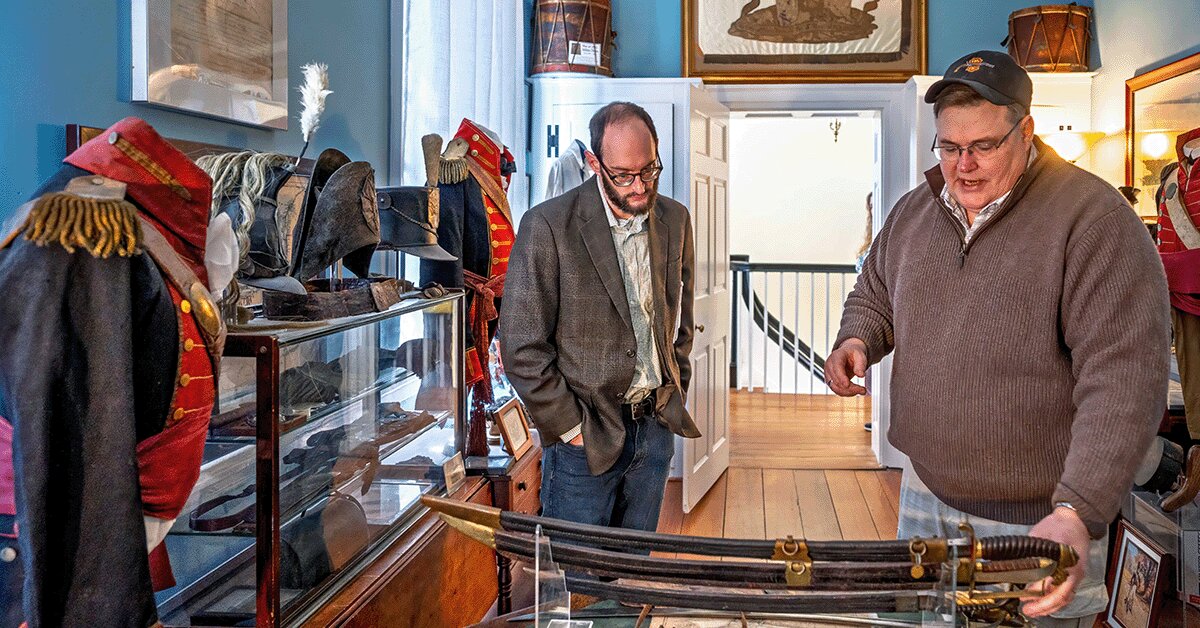


WILLISTON – On a recent visit to historic Potter Hall in Williston, a Revolutionary War historian unexpectedly found a major artifact tied to a Caroline County native who served in a pivotal early battle.
Chris and Wendy Grazzini, who own the Federal-era home on the Choptank River, welcomed Owen Lourie, a historian at the Maryland State Archives in Annapolis, for a tour of their home and Chris Grazzini’s extensive War of 1812 collection.
Lourie is the senior research archivist as well as project director of the “Finding the Maryland 400” research project. For more than a decade he’s been gathering research on the Maryland soldiers who, on Aug. 27, 1776, fought the British in the Battle of Brooklyn under the command of Gen. George Washington. It was the first major battle of the Revolutionary War and it proved the mettle of Maryland’s courageous soldiers.
The project is a partnership between the Maryland State Archives and the Maryland Society of the Sons of the American Revolution, who are studying the First Maryland Regiment. “At the Battle of Brooklyn (also called the Battle of Long Island), the heroic stand of the ‘Maryland 400’ held back the British Army,” the Archive’s website states. One historian has called these soldiers “Washington’s Immortals.”
According to the project’s website, msamaryland400.com, “about half of the Maryland troops were able to safely retreat during the Battle of Brooklyn, including the First Company. Those who could not escape, the ‘Maryland 400,’ launched a daring counterattack, forcing the British back, at the cost of many lives.”
Piecing together the history of the Maryland 400, Lourie is seeking authentic biographical information and historical artifacts to aid his research. After learning about Chris Grazzini’s collection, he journeyed to the Eastern Shore to learn more.
Grazzini is a serious collector, established expert and published researcher. After a 26-year career in the Air Force, he retired as a colonel, and for the past eight years he has worked for the Department of Homeland Security. He is a member of the exclusive American Society of Arms Collectors, and he owns rare artifacts, swords, flintlocks and the largest collection of U.S. War of 1812 uniforms in the country – “more than the Smithsonian, more than West Point, more than Ticonderoga,” he said.
While Grazzini’s collection is focused on the War of 1812, one of Grazzini’s four Maryland swords caught Lourie by surprise.
“This is just a British hanger,” Grazzini said as he took the sword down from a mantle in the dining room. “Nothing sexy about it. It’s a pre-Rev War, utilitarian French scabbard, which is interesting (because) it actually reinforces the story of it.”
That “story” was a simple phrase written on a slip of paper, or provenance, that accompanied the sword when Grazzini bought it from an “old-time collector.” Propping his glasses on his forehead, Grazzini read, “From the estate of Sergeant, Ensign and Lieutenant Peter Hardcastle …”
“Holy (cow)! He’s one of my soldiers!” Lourie interrupted, surprised when he heard the name. “He’s genuinely one of my soldiers. He's part of the famous Maryland 400 who I'm writing my book about,” he said.
Grazzini continued reading the descriptive provenance: “… Peter Hardcastle of the 4th Company, First Maryland Regiment, Talbot County, 1776-1782.” Peter Hardcastle was a member of Caroline County’s Hardcastle family; Thomas Hardcastle built the historic late Georgian “Castle Hall” near Goldsboro.
Grazzini explained that “what reinforces that this (sword) is legit” is that it is a French scabbard, as well as the fact that he didn’t pay for the story, which is a key point in establishing the reliability of the provenance.
“It makes sense, too, because he starts out as a sergeant, and then, as a company officer, he would continue to wear it because it's a very functional weapon, because you’ve got to remember, sword fighting is like MMA – mixed martial arts,” Grazzini said. “When fighting is that intimate and that close, (you do) whatever works, so this is a very functional, utilitarian fighting weapon."
“I cannot prove 100% that that is his sword, but it is certainly typical of what he would have carried. It matches the story,” Grazzini said. “I truly do believe this because no money was exchanged for the story. And most people wouldn't know to make up this story.” Or, if they knew the age of the sword, would claim a much greater personage like George Washington as the owner, he said.
Lourie noted the difference between Hardcastle’s basic sword and the elegant sword worn by Col. Tench Tilghman and featured in the painting “Washington, Lafayette & Tilghman at Yorktown” by Charles Willson Peale.
Lourie hopes to include photos of the Hardcastle sword to accompany the biography of the solder in the Finding the Maryland 400 website and book.
For more information about Finding the Maryland 400, visit https://msamaryland400.com/, where you can read Peter Hardcastle’s biography and service in the Revolutionary War.


