
The Local Source for News and Information Since 1980
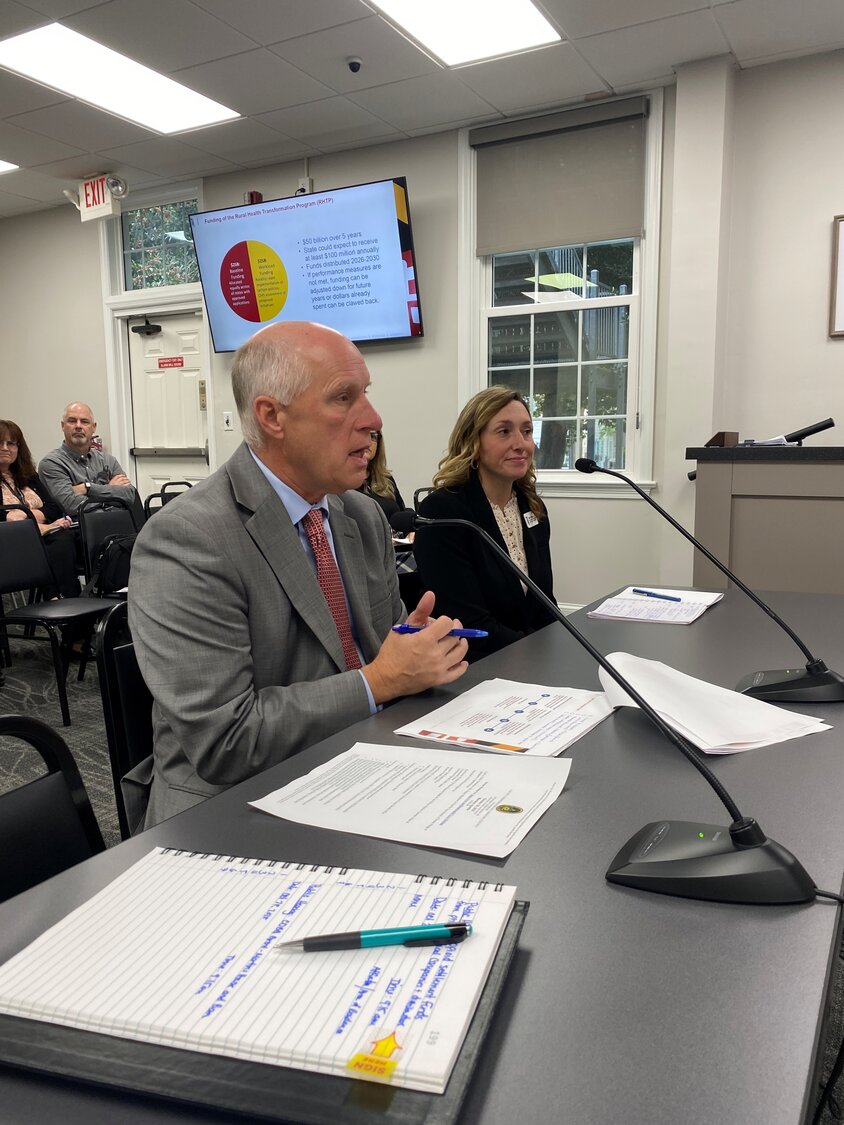


DENTON – In a marathon meeting lasting over four hours Tuesday, Oct. 28, 2025, the main focus was on health, and the Caroline County Commissioners heard an update about the new regional health facility and efforts to serve Caroline County residents.
Headlining the meeting was Ken Kozel, president of University of Maryland Shore Regional Health (UM SRH), and Lara Wilson, UM SRH director of external affairs and community liaison.
Kozel presented a slide show titled “Transforming Health Care on Maryland’s Rural Mid-Shore,” providing an overview of rural health care in the United States today, changes to the Maryland payment model, progress on the Shore Regional Medical Center under construction in Easton and specific developments related to Caroline County.
Rural hospitals throughout the country are facing financial pressures or have closed, Kozel said. With only a 1% to 1.5% profit margin, efforts to contain costs are ongoing. “Trying to keep the business afloat with very, very thin margins,” is a challenging, he said.
Nationally, half of all rural hospitals have negative operating margins, with over 200 rural hospitals closing in the past 20 years. Hundreds more are at risk for closure. Obstetrical services and chemotherapy services have ceased in hundreds of rural hospitals in the past decade.
“The country is not good at reimbursing providers; they typically don't make a lot of money for the care that they provide,” Kozel said. Therefore, it’s more difficult for physicians to remain in private practice, causing them to seek employment. “The state of Maryland is among the worst states in the country for reimbursing for physician services. So we're already at the bottom of that spectrum. But when you look at rural health care on top of that, that's even worse.”
“Hospitals like us need to reinforce, need to invest in those providers to provide the care that we (need),” Kozel said.
“We were a 3-hospital system when I got here. We found, though, that we just can't sustain that level of care in this small region with the low population that we have,” Kozel said. “Fortunately, with the things that we've done on the hospital side, and with adding urgent care facilities and free-standing (healthcare centers), that's helped us sustain ourselves and really helped us thrive.”
“Maryland is still that unique state that offers the only payment system in the state in the country that's unique, and the federal government is working with Maryland on trying to advance this payment model … called the AHEAD model,” which “really focuses us on taking care of preventative health … through primary care,” Kozel said.
By focusing on improving outcomes of those with chronic diseases, the hope is that costs will be reduced,” Kozel said. “What we're doing right now is finalizing the negotiations between the state and the federal government” for the 10-year AHEAD plan by the end of 2025.
AHEAD stands for Advancing All-Payer Health Equity Approaches and Development. Currently, the model is limited to eight states. According to the Centers for Medicare & Medicaid Services (CMS), the AHEAD model is “a state total cost of care (TCOC) model designed to curb growth in health care cost spending, improve population health, and advance health equity by reducing disparities in health outcomes.”
Kozel said the federal One Big Beautiful Bill Act of 2025 includes a $50 billion, 5-year allocation for rural health care, the Rural Health Transformation Program (RHTP). The state’s application for $100 million annually should be ready to submit next week, with notification of the state’s allocation by the end of 2025. Kozel is advocating for increased funding to provide more primary, as well as specialty care, for the Mid-Shore counties (Kent, Queen Anne’s, Caroline, Talbot and Dorchester) served by UM SRH.
The UM SRH primary service area comprises 2,000 square miles and, with a population of 172,000, it “represents 25% off all the healthcare performed in the state of Maryland,” Kozel said. Almost 50% of residents receive Medicare and Medicaid. About 8,500 people in the area have no health insurance.
The need for healthcare employees on the Mid-Shore is “one of our biggest challenges,” Kozel said. He credited Dr. Bruce Jarrell, a Caroline County native and resident, who is president of the University of Maryland, Baltimore (UMB), with “leading the way in helping us provide more providers on the Mid-Shore and rural areas across the state.” Jarrell is helping create the Rural-MD Scholars Program. “This is a program that adds 10 slots to the University of Maryland School of Medicine's medical school. … for rural health care providers.”
Students in the program agree to provide health care in rural areas for four years in exchange for tuition and fees reimbursement.
Kozel said the UM SRH Pavilion in Denton “is really doing very, very well. We've got a very strong primary care base here in Denton. We've got a very strong support services with rehab, with ancillary testing in the building. It's very well used. It's an important part and component of our services, as is the urgent care center.”
The UM SRH Urgent Care location in Denton had 15,700 visits in 2024. “We're really serving the community. It's open seven days a week. It also has telemedicine access, which is really great,” Wilson said. “And Caroline County actually has led our region for the alternate destination program, which is the partnership …with EMS, where you can triage patients and determine whether they need to go to the ER or whether they can be seen in the urgent care. … It's an amazing program. It's really helping the patients have the right care at the right time.”
Commission Vice President Larry Porter said the Urgent Care center, “has been a godsend to us here, and the Pavilion as well.”
Wilson said UM SRH is also partnering with county programs, including law enforcement agencies, to provide wraparound services, including behavioral health and mobile integrated health (MIH) services.
The UM SRH PharmD program will join the Caroline MIH team beginning January 2026, “and that's really, really exciting,” Wilson said.
“About 50% of the patients that come back to the hospital after they've been discharged come back to us because of medication mismanagement,” Kozel said. “So having that PharmD access with the patients directly to help manage that is critically important to keep the patients out of the hospital as best we can.”
Commission President Travis Breeding said helping patients avoid a trip to the hospital because of medication mismanagement “saves the county a tremendous amount of resources.”
Behavioral health care is the “number one concern” both locally and statewide, Kozel said. UM SRH is looking into the possibility of an in-patient behavioral healthcare unit for children and adolescents at the Chestertown hospital facility.
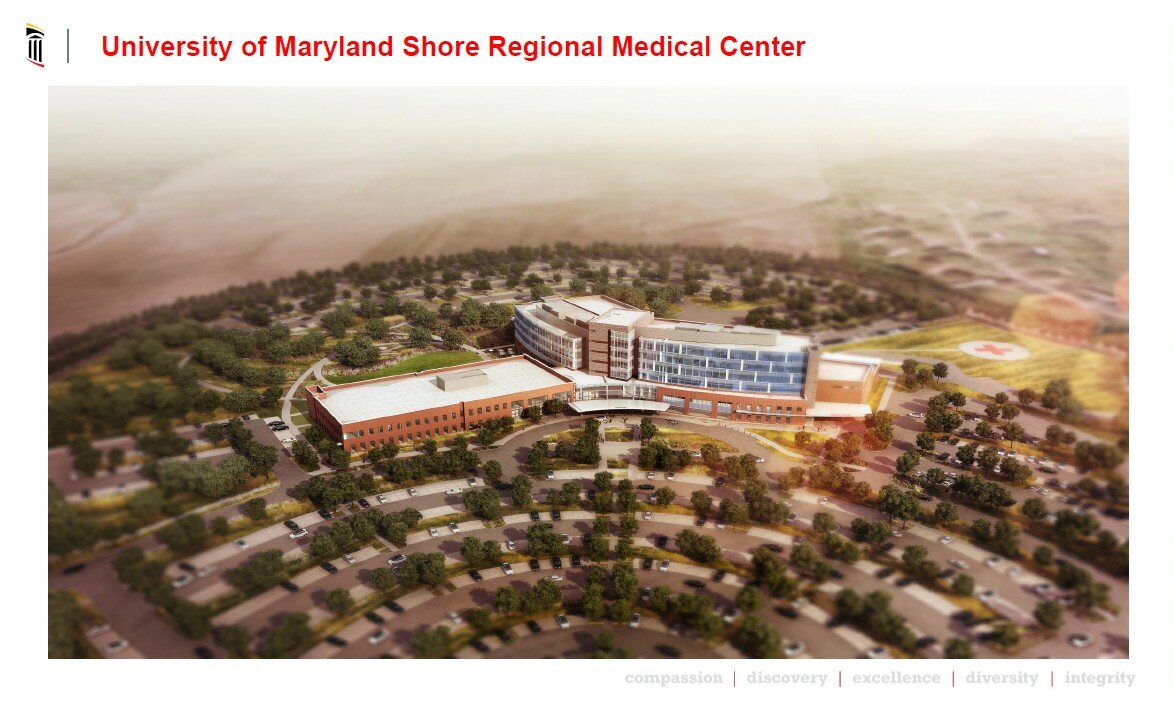
The University of Maryland Medical System Regional Medical Center has been under construction for a year. Kozel shared an update with photos on progress so far about the building project off U.S. Route 50 west of Easton near the Talbot County Community Center. The facility is expected to be open by late 2028. It will have 147 beds, 29 more than in the downtown Easton hospital, which is for sale.
Kozel thanked the Commissioners for supporting Chesapeake College, a “workforce pipeline” for UM SRH. Caroline students are also being reached through mentorship and STEM programs, partially sponsored by UM SRH.
# # #
Cutlines:
4452 – University of Maryland Shore Regional Health President Ken Kozell, left, and Lara Wilson, UM SRH director of external affairs and community liaison, update the Caroline County Commissioners. (Photo by Connie Connolly)
SRMC 10-2025 – By the end of 2025, the Shore Regional Medical Center under construction west of Easton will look like this. (Courtesy of University of Maryland Medical System)
UM SRH Center rendering – Construction of the Shore Regional Medical Center in Easton is slated for completion by late 2028. (Courtesy of University of Maryland Medical System)


