
The Local Source for News and Information Since 1980

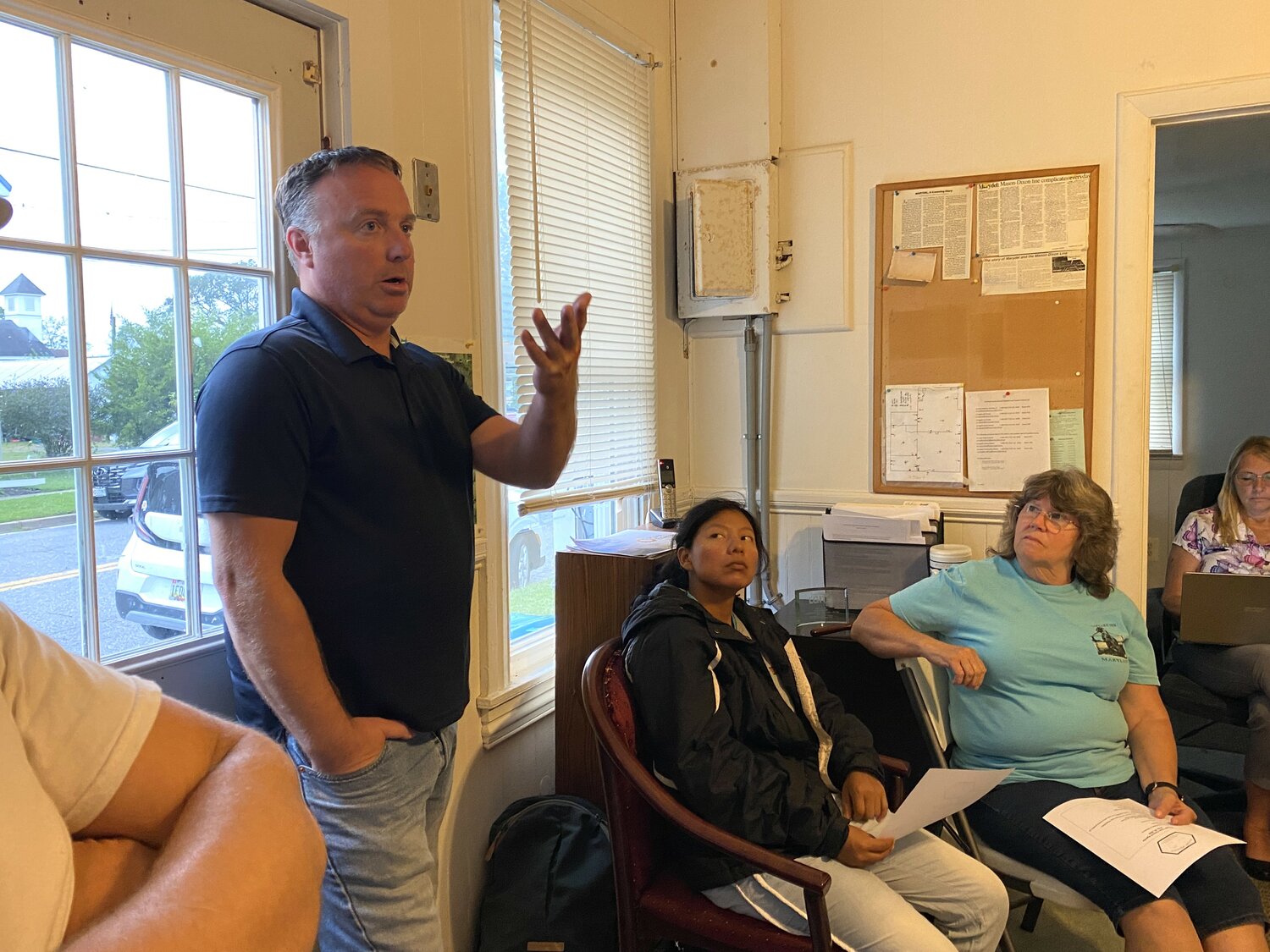


MARYDEL, Md. – A possible “solar garden” occupying a 10-acre parcel of agricultural land straddling the Marydel-Caroline County line drew almost two dozen residents to the tiny town hall meeting room Wednesday evening, Aug. 20, 2025.
Solar project planners from Denver-based Pivot Energy presented the proposal and answered questions during the 2-hour meeting. Providing background and context for town commissioners and attendees to consider were State Del. Jeff Ghrist (R-36), Caroline County Commission Vice President Larry Porter and County Planning and Codes Director Crystal Dadds.
Social media posts on the town’s Facebook page prior to the meeting stated mostly opposition to the project in principle and referred to the sprawling utility scale solar project on nearly 800 acres along State Route 313 between Goldsboro and Greensboro.
At the meeting, resident John Haley said bluntly, “Solar panels make me sick.”
Jeanette DeLude, circuit rider with the Maryland Rural Development Corporation, explained the town currently has no solar regulations in its comprehensive plan, which hasn’t been updated since 2009. No permits can be issued until the regulations are updated. She said more meetings and hearings would need to take place before a decision could be made.
Town Commissioners Catherine Pharis and Todd Trambarulo were present, as well as Brian Pincin, town planning and zoning director. Mayor Elizabeth Simmons was absent.
Pivot Energy Project Development Director Seth Shafer and Sophia Hill, senior manager for policy and market strategy, introduced the proposal.
Shafer and Hill provided a packet and handouts about the project, which, among other features, would use only Delmarva Power’s transmission lines; Choptank Electric Cooperative customers would not be eligible to subscribe to the community solar project. While topsoil would be removed, a variety of grasses would be planted, and, as an “agrivoltaic” solar project, local farmers would be contracted to supply sheep to graze among the solar panels to maintain the property.
The presenters said subscribers could receive a 10% to 20% discount on their electric bills. The 1-megawatt project would serve 250 to 300 homes or businesses. At least 40% of community solar residential subscribers are required to be low-income.
Residents expressed concern about the safety of the solar panels themselves and the state of the soil when the solar panels are decommissioned in about 25 years. Shafer said the panels, built in South Carolina, are made of silicon with “a very small amount of silver in it.”
Dadds advised the town commissioners to consider the residential and commercial zoning of the vacant property, which is in the town’s growth area, as well as in the county’s priority funding area.
“Most of your parcels within the town are already developed,” Dadds said. The 10-acre property across from the post office could be instrumental in “growing your town and having your town survive.”
“Obviously, right now you have limitations due to not having sewer, but that is in your growth area,” Dadds said.
Ghrist emphasized the uphill battle the Eastern Shore delegation and Caroline County Commissioners faced in Annapolis during the 2025 Maryland General Assembly. He said legislators didn’t trust local jurisdictions “when it comes to zoning … (because of) ideology.”
“To be quite honest, the state should have no say” in solar siting, he said. “It should be local control.”
“They set these renewable energy goals 10, 15 years ago that are unachievable, to be quite honest,” Ghrist said. He said covering productive farmland with solar panels was “stupid.”
“I'm not here to say that solar companies are evil,” he said. “I'm here to say the position that I took was that we shouldn't be covering up productive farmland with solar panels, and not to the tune of thousands of acres. You guys are talking about 10 acres here. What we are fighting is 50,000 acres on the Eastern Shore. We're fighting 8,800 acres or more in Caroline County – that's what we're fighting. And we're choosing energy security over food security. We don't have to make that decision. We can do both.”
Porter summarized the work the County Commissioners and county staff has done since 2017 to plan for and limit solar sprawl. However, the 2025 Renewable Energy Certainty Act placed control of utility scale solar siting in the hands of the Public Service Commission, “made up of five Governor appointees, none of whom are from the Eastern Shore,” he said.
Porter said there was “one thing I want everyone to understand. There has not been one acre of solar that has been put in this county that hasn't been agreed to … by a farmer. No one has been forced to do anything. No one's land has been taken. There is no eminent domain in place.”


