
The Local Source for News and Information Since 1980
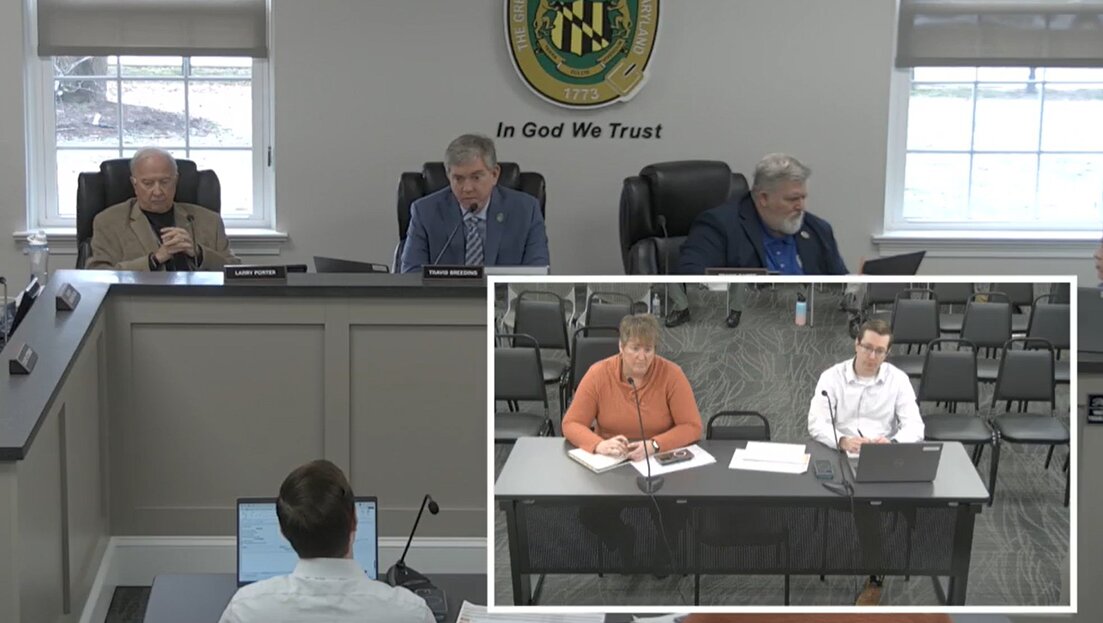


DENTON – As the Caroline County Commissioners prepare for their budget roundtable Tuesday, Feb. 25, a number of factors beyond their control are breathing down the fiscal neck of the county.
At the Feb.18 budget overview session, the commissioners learned they are facing a $2.3 million increase in expenses that stem mainly from the state of Maryland passing expenses on to the counties.
The Commissioners didn’t mince words criticizing state leaders during the Feb. 18 morning meeting or the evening work session with the Board of Education.
“There is no leadership at the state level,” Vice President Larry Porter said. “We need some adults in the room over in Annapolis.”
The main drivers of the increases are the Blueprint for Maryland’s Future, a 10-year plan to improve student achievement, and other state mandates.
“There's no adult that's going to tell somebody, ‘No,’” President Travis Breeding said. “Nobody is going to tell the solar lobby or the teachers union ‘No.’”
The state is facing a budget deficit that is projected to be about $3 billion in fiscal year 2026.
Compounding the increased expenses being pushed to the county is confusion surrounding the formulas for determining the county’s share, a problem that has plagued school superintendents since Blueprint was enacted as state law in 2021.
And to make matters worse, another comprehensive education bill was unveiled by Gov. Wes Moore’s administration Feb. 19. Known as Excellence in Maryland Public Schools Act or House Bill 504, one of proposed bill’s objectives is to slow the growth of per pupil spending for the next eight years.
However, according to Caroline County Public Schools Superintendent Dr. Derek Simmons, HB 504 would also “make significant changes” to collaborative time and teacher recruitment, teacher retention and development, and community schools.
In the school board’s work session with the Commissioners Feb. 18, Simmons said this year he hasn’t “been able to figure out the formula” to help the Commissioners prepare a budget in the long term.
Simmons described a “nightmare scenario” of trying to track a teacher’s salary over multiple buckets, a complex and confusing process that has still not been clarified by the state.
Breeding was concerned that, at the district level, “there may be a lot of time and effort and money wasted setting up a structure that the legislature and the governor doesn’t have the will to raise taxes to actually fund.”
“You got to continue to drive towards that cliff hoping that the revenue stream is there,” Breeding said. “But it seems to us like they don't have the will to tax the middle class, which is what they're going to have to do. It's the only way they're going to pay for Blueprint.”
“All the information that we're hearing is the only way it can be done is by raising taxes on everyone,” Breeding said. “And they're going to lean on us to do it, which we don't have the tax base to do.”
“It’s just not sustainable,” he said.
Porter added another potential impact on the budgeting process.
“And then the other thing that's killing us that we don’t know is the Governor's proposed income tax rebracketing, which reduces our revenue by $1.4 million in this fiscal year, and $1.1 million for every year after,” he said.
Fox said, “In environment when they're shifting costs over to us, they're reducing our taxing ability while shifting costs from the state.”
Breeding said the Commissioners also need to “put enough money away to keep up with our capital needs, as well” – items that are not factored into the operating budget.
“We need office space. We need a middle school. We need a detention center,” Breeding said. “To Commissioner Bartz's point, we should look at converting some of these dirt roads for some of the people in the denser housing areas on dirt roads. It's time to tar and chip them.”
During the Commissioners’ regular morning meeting Feb. 18, Deputy County Administrator Daniel Fox and Grant Coordinator Stacy Seward presented an overview of requests from county departments and agencies. At the Feb. 25 budget roundtable, the commissioners will hear from the department and agency leaders, who will explain their requests.
The fiscal year draft budget of $80 million, “is outpacing the estimated increase in revenue of around $900,000,” Fox said.
“My message for all of our department heads and allied agencies coming in: It's not that we enjoy asking hard questions or scrutinizing everything,” Breeding said. “I don't like sitting up here and telling people no, we can't do stuff, but they need to be prepared for tough questions because I think we're going to have to scrutinize everything.”
“We'll get to a zero budget, and we'll make it through,” Fox said. “But how many consecutive years of that occurring can happen before you start have to re-look at the services that are provided?”


