
The Local Source for News and Information Since 1980
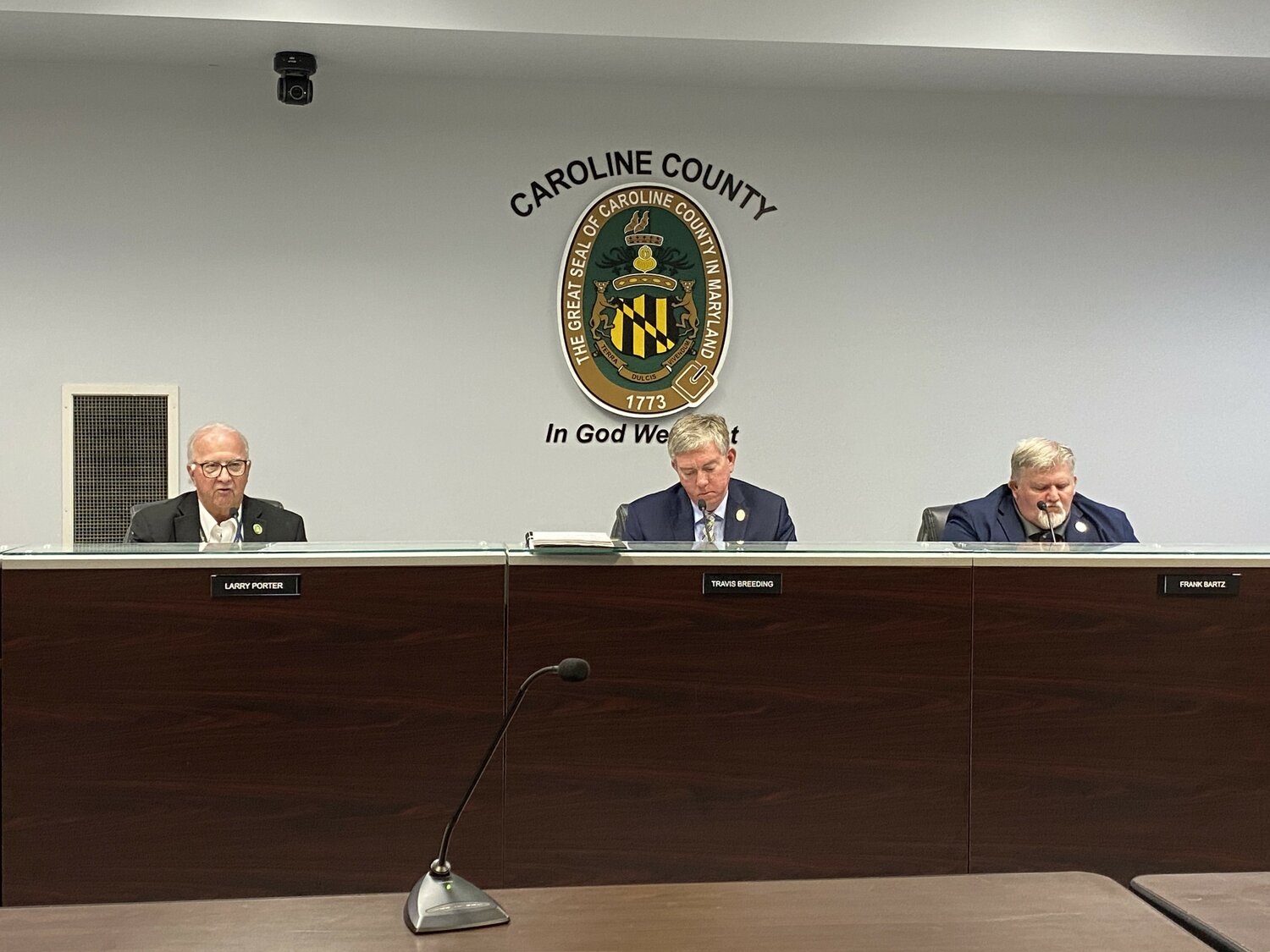
DENTON – The road to a balanced fiscal year 2026 budget has been a bumpy one for the Caroline County Commissioners and county finance staff, but the finalized version was presented at an hour-long evening public hearing May 6 at the Health and Public Services Building in Denton.
The belt-tightening that affected some nonprofit organizations resulted mainly from the state’s passing on unfunded mandates to the counties.
If there is any good news, the Commissioners maintained the same $.98 property tax rate that has been in place for a decade with revenue increasing steadily, and the 3.2% income tax rate that has been unchanged for eight years.
The projected FY2026 budget is $77,651,063, an increase of over $5.3 million from the FY2025 budget.
“It's a long, grueling process,” Commission President Travis Breeding said as the three public hearings concluded.
The three hearings covered proposed operating and capital budgets, proposed tax rates and proposed municipal real property tax differential rates. A handful of attendees shared their thoughts with the Commissioners.
Deputy County Administrator and Finance Director Daniel Fox presented a PowerPoint slide show and explained budget highlights, beginning with county revenues. Property taxes account for 45.6% of revenues; income taxes, 32.5%; and other income, 21.9%, which comes from permits, fees, charges for services, interest on interest-bearing accounts and transfers in from other funds supported by the general fund.
As for property taxes, Fox said, “We are seeing the same as every other county across the state, and have been showing really steady growth over the last couple of years.”
The FY2026 property tax income estimate is $32,852,800, which is 2,283,700 higher than the FY2025 budget and more than $4 million above what the county brought in during FY2024.
“I think we are very fortunate that we have been in a position where we can absorb those cost transfers without having to raise any property taxes,” Breeding said.
Income from permits and fees have held steady, but a proposal to add a new pre-Certificate of Public Convenience and Necessity (CCPN) solar review fee is on the table, as a result of an increased number of solar facility applications.
“So, this year was really a unique year for us,” Fox said. “In past years, we're normally about a million dollars or so out of balance where we have a million more in expenses requested versus available revenue.”
This year the expenses came in at more than $5 million over projected revenue – and they’re mostly state-driven.
While the challenges are significant, Fox said some positive developments are:
“We felt it was important to build those (retirement) funds and have those funds available,” Porter said. “We have people who work for us and do a good job, and (it’s important to) be able to look them in the eye and say, ‘You'll be taken care of when you retire.’”
The hearing on the municipal real property tax differential rates prompted Ridgely Town Commissioner Brad Sears to ask what the county’s future fiscal picture might look like.
“I very much appreciate the challenge that you have faced, given what's being passed down to us from Annapolis,” Sears said.
Commission Vice President Larry Porter explained the tax differential, saying, “if you live in an incorporated town, you'll pay less of a county property tax rate” when it provides police protection.
“This is something that was in play when I came into office 15 years ago, and it has been a real subject that I have battled with over the years,” Porter said. “It does not affect the town budgets. It means that it is less money that the county collects in their county property tax rate.” The amount the county didn’t collect in the FY2025 budget is $600,000, Fox said.
“This will be the last year that I will support the property tax differential,” Porter said. “My preference is going to be to give it to all county taxpayers, not just people who live in municipalities. That's going to be how I'm going to approach it.”
“We will not be able to forego $600,000 in revenue in the coming year,” Porter said. “I see nothing but costs being shifted every year (from the state).”
“That makes sense,” Sears said. “Again, what I'm looking at is the cost of local police protection and trying to at least prepare my constituents for what's likely to come down the path. Because, let's face it, costs continue to increase. I'm very sympathetic to the situation that you gentlemen find yourselves in.”
Breeding addressed the position Caroline County is in with regards to the state’s “disparity grant” because the county’s “income tax receipts are so much lower than the state average.” He was concerned that the state may adjust the formula to the county’s disadvantage after FY2026.
According to the Maryland Department of Legislative Services, four counties on the Eastern Shore (Caroline, Dorchester, Somerset and Wicomico) received disparity grant funding in 2025.
Porter returned to his frequently voiced concern in past weeks that the state legislature is moving more “toward taking authority away from local governments.”
Breeding said that while he was originally opposed to the new Queen Anne Career and Technology Center at Chesapeake College the five supporting counties are funding, he was previously assured by Dr. Cliff Coppersmith, who attended the hearings, that county students would be able to use the facility.
Breeding also addressed the cutbacks on funding nonprofit organizations. For instance, both Martin’s House and Barn and His Hope Ministries are not funded in the FY2026, budget, despite receiving $5,000 each last year, and CASA for Caroline and Aaron’s Place are funded $5,000, as they were in FY2025.
“I respect everything that those nonprofits do. They do very important work in the community,” Breeding said. “But my position has been that if we want to contribute personally, … we should do that. I don't feel comfortable using taxpayer dollars to make contributions to those organizations.”
Breeding said his “least favorite part” of the job was “trying to figure out what is the best for everyone, and having to tell people, ‘No, I'm sorry. I appreciate what you do. I think that your program or your service that you're providing is vital, but we can't fund it.’”
The Commissioners thanked county staff for their hard work and praised past Commissioners for their fiscal restraint and foresight to put aside funds for a rainy day.


